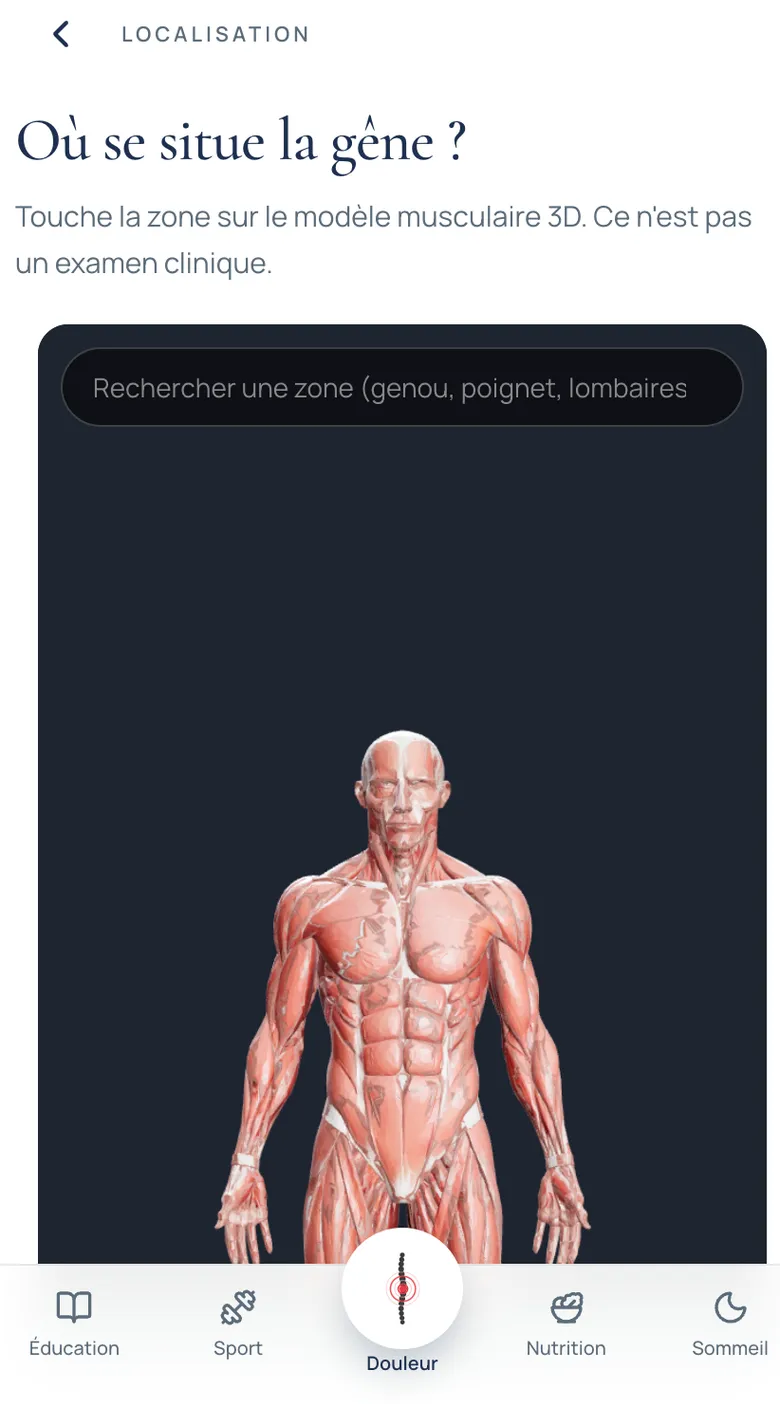
Show it on a 3D body map
Pick the area on a 3D body, front and back, instead of hunting for the right word.
Coming soon to iOS and Android

Pillar
Pain is a signal. Learn to describe it and keep track of it.
Your knee, back or shoulder is bothering you. You're not sure whether to stop, carry on or talk to someone. Lots of people wait for it to pass, or push through the pain. This part helps you describe clearly what you feel, understand the pointers that matter and know when to get checked.
The Pain pillar includes one analysis in total. Once you've used it, the whole pillar is locked (new analysis, guides, exercises and trend line) apart from that analysis's history, which you can still view. Warning signs and guidance on who to see are always available. The other pillars work as usual.
Pick the area on a 3D body, front and back, instead of hunting for the right word.
What it feels like, when it shows up (during effort, at rest, when you wake up), how long it's been going on, what makes it worse and what eases it.
A score from 0 to 10, plus a photo and a note if you like. When you come back, you'll see how it's trending.
They pick up situations where it's better to get checked than to manage on your own. They're always free.
Every guide follows the same order: recognising it, the aim, what to do, what to avoid and when to get checked.
Note the intensity before and after, and how tired you feel, to see the effect over time.
You can share your guide; on Gold and Family you can also export your summary as a PDF.
Where, what it feels like, how strong, and the context.
The app gives you a guide, careful pointers and, if needed, tells you which professional to see.
Trend line, exercises and weekly summary.
Illustrative examples: made-up people, not real users.
Léa, 29
Léa runs three times a week. She marks an ache in her knee, rates it 4/10 on downhills and reads the matching guide. If it doesn't settle, she knows what to tell her GP.
| Depending on your plan | Free | Silver | Gold | Family |
|---|---|---|---|---|
| Pain warning-sign checks (never behind a subscription) | Yes | Yes | Yes | Yes |
| Referral to a professional (warning and signposting) | Yes | Yes | Yes | Yes |
| Pain analyses and guides | 1 in total | Unlimited | Unlimited | Unlimited |
| Full pain history | No | Yes | Yes | Yes |
| PDF export of your summary for a health professional | No | No | Yes | Yes |
The app isn't available yet. Leave your email: we'll only write to tell you when it launches. You can unsubscribe at any time.